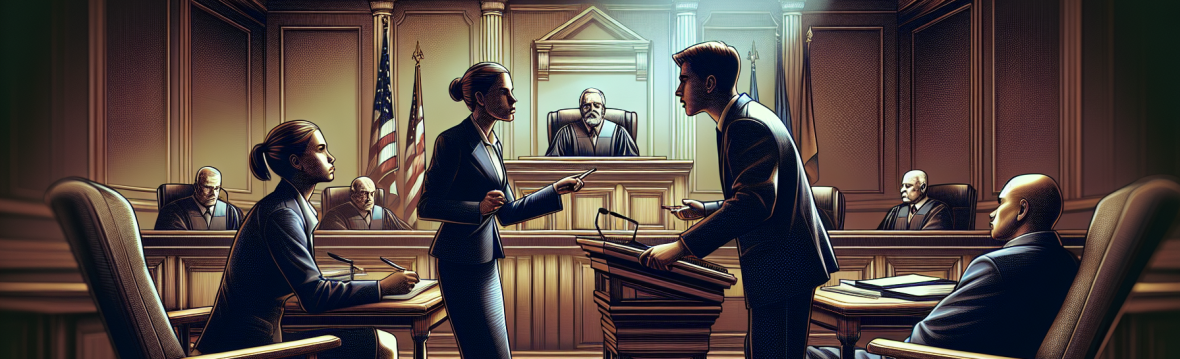
Hands down, the #1 question I get asked these days is “what’s it like on the defense?” Yes, two years into making “the switch,” I still get asked this question. At first, I did not understand why. After all, justice is justice, right? It shouldn’t matter what “side” you are on?! Quickly, though, I got it. And the simple answer to the question is, “the tunnel guiding my vision has just gotten wider.”
For ten years, I served as an Assistant United States Attorney (common speak, I was a federal prosecutor). I loved it. You’ll hear many people say that serving as an AUSA is the greatest job in the legal profession and, yes, it’s pretty high up there. There are no billables, the cases are complex, you have a team of agents and fellow prosecutors in your corner, you try a ton of cases and appear in court nearly every day, and, for many, you are “wearing the white hat.” That means you are the “good side” of the law. Indeed, you serve the community – and justice – at large. You do not represent a person; rather, you represent the people. It is not just a job; it is a calling.
You can see why I stayed for so long. Having come from the biggest and baddest of Big Law (I was an associate at Kirkland & Ellis for many years), I loved investigating, indicting, and trying my own cases and the comradery of the office. So, why did I make the switch to the “dark side”? And how did it feel? I won’t lie; it was a scary move. There comes a time for every prosecutor when you have to ask yourself, “Am I a lifer?” Do I want to do this forever? The doors of leaving the government to return to private practice do not stay open for “lifers,” I was advised. While I knew I loved my role, I also knew I wanted to experience more in the law to be well-rounded. Moreover, I wanted to get out of the tunnel I was in – and see cases, and people, from a completely different standpoint.
What’s the tunnel, you ask? I can’t speak for all prosecutors, but for me, the focus of my investigations and cases were not on the individual(s); it was on the offense(s). What was done? How egregious was the act(s)? How many were victimized or harmed? Considering the defendant’s background and situation were certainly part of the equation in weighing whether to charge, what to charge, what plea to offer, and, ultimately, what sentence to advocate for. But it was not necessarily at the forefront of considerations. I did not realize how little so until I moved to the defense side. In fact, I thought of myself as a fair, equitable prosecutor who tried to see people as people and who did the “right thing”. But, being a defense lawyer has showed me that tunnel vision is not the result of ill-will or judgment, but the nature of the practice of criminal law. Prosecutors just do not – and cannot – speak to targets/defendants the way their own lawyers do. They do not share the same view of the case, charges, and defendant(s) because they cannot understand their stories the same way. The system is not designed for that.
I wasn’t fully ready, to be frank, for the tunnel to get wider… for my vision to be expanded. I could not expect to get so close to clients and charged defendants, to see them beyond the scope of offenses and as men and women who are flawed, but somehow good, humans. My first sentencing hearing was tough because of this. I cried like I was in mourning. I was so depressed. I thought about my client’s family every day. These considerations are ones you just never have as a prosecutor, or at least I did not. As a prosecutor, a lengthy sentence was never a cause for celebration, but somehow, it felt righteous. Justice was served, though bad acts were done. As a defense attorney, I think long and hard about each day my client spends in prison. I now think of the person’s full story and less about the charged conduct. About the impact to a family, not just a defendant.
And if I am fully honest in answering what life is like on this side, I must say, it is not dark at all. In fact, there is more light in my tunnel now. The tunnel is wider and has greater perspective. Having served as both a prosecutor and defense attorney, and giving my all in both capacities (yes, people, you can 100% do both well), I realize that I am a better lawyer for it. To strive for a better justice system, you must understand the ins-and-outs of how it operates, and that, I do. Each and every day, I now embrace the different views that come my way and encourage you to do the same. Our justice system is all the better for it.
- By Vanessa S. Johannes